


The 2008 Program
| Dates | Venues | Program | The Players |
| 10th Oct 11th Oct 12th Oct |
Meadowbank Estate, Cambridge Home Hill Winery, Ranalagh "Mountford" Ballroom, Longford |
Vivaldi Concertos (see below for details) |
Susanna Lazaroff, Alison Lazaroff-Somssich, Rosalin Lazaroff, Miranda Carsons, violins, Janet Rutherford, viola, Brett Rutherford, cello, Stephen Martin, double bass, Dinah Woods, oboe. |
Notes |
|||
|
Antonio Vivaldi: 1678-1741 Red-haired Vivaldi became a priest in 1703, but was almost immediately excused from saying Mass. He claimed to be incapacitated by illness, probably asthma. Illness did not prevent him from getting a job that year at the Conservatorio delta Pieta, a girls' orphanage in Venice that emphasized music education. Vivaldi taught violin to the girls, and wrote hundreds of works to be performed by the Pieta's excellent orchestra. Asthmatic or not, in 1713 Vivaldi took a working leave of absence, probably to compose an opera. From that time on he spent a great deal of time away from the Pieta, producing his operas all over Italy and hobnobbing with nobility. During this period, publication of some of his orchestral works brought him fame throughout Europe. The governors of the Pieta finally had enough of Vivaldi's truancy, and declined in 1738 to renew his contract. The composer continued to wander around Europe with a base in Venice. Vivaldi's activities brought in quite a bit of money, but he was such a big spender that he died with hardly a ducat to his name in 1741. 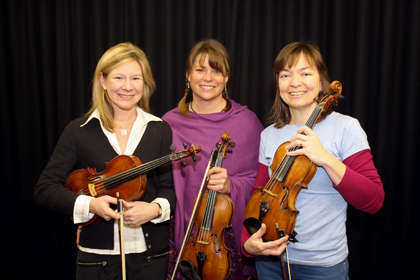 Violinist sisters, L to R, Rosalin Lazaroff, Suzanna Lazaroff and Alison Lazaroff-Somssich, who performed as a trio for Virtuosi in October. Photograph courtesy of The Mercury. Vivaldi Concerto Grosso Op 3 No 11 in D minor.
For more information: |
|||
| Dates | Venues | Program | The Players |
| 12th Sept 13th Sept 14th Sept |
Meadowbank Estate, Cambridge Peppermint Bay, Woodbridge Devonport Regional Gallery, Devonport |
Franz Bernwald, Septet and Jean Françaix, Octet. |
Chris Waller, clarinet, John Panckridge, bassoon, Wendy Page, horn, Lucy Carrig-Jones, Miranda Carson, violins, William Newbery, viola, Paul Taylor, cello, and Stephen Martin, double bass. |
Notes |
|||
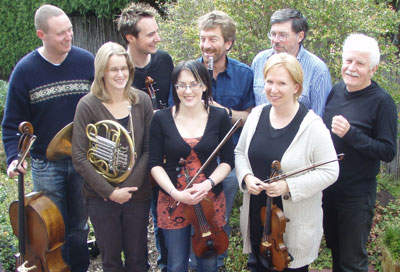
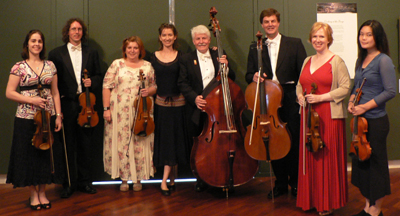
L-R Paul Taylor, Wendy Page, William Newbery, Miranda Carson, Chris Waller, Lucy Carrig-Jones, John Panckridge, Stephen Martin. It’s somewhat mysterious why the highly appealing, innovative and well crafted music of the Swedish composer Franz Berwald failed to receive its due recognition during his lifetime. Nowadays Berwald is recognized as a composer worthy of note.
The Grand Septet in Bb uses the same instrumentation at Beethoven's Septet, which was a concert favourite in Stockholm as elsewhere in the early 1800s. Berwald's Septet was published in 1828 - probably not coincidentally, the same year as the Schubert Octet - but may be a reworking of an earlier (and now lost) septet from 1817. Its melodic charm, effective instrumental writing and structural interest justify the Septet's position as the most often performed of Berwald's works. Adagio: Allegro molto
Jean Françaix, Octet for clarinet, basoon, horn, 2 violins, viola, cello and bass 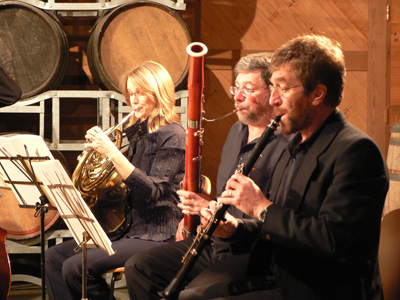
Chris Waller, John Panckridge, Wendy Page playing the Octet at Meadowbank Estate. Jean Françaix was born into a musical family in Le Mans. Encouraged by Maurice Ravel, and a pupil of Nadia Boulanger, he is one of the most frequently played French composers in the world today. His Octet is modelled on Schubert's in F major D. 803 (1824). It is cast in four movements instead of six and includes that most Viennese of dances, the waltz. As far as the writing is concerned one is immediately struck by Françaix's more integrated instrumental approach, with a strong string presence. There is plenty of classical restraint but that doesn't preclude the odd flashes of wit and humour. The moderato – allegrissimo and scherzo elicit some virtuoso playing from both woodwind and strings The andante is measured and there are some lovely sonorities to savour. The concluding waltz is more Second Viennese than First in its initial jaggedness. Moderato, Allegressimo |
|||
| Dates | Venues | Program | The Players |
| 25th April 25th April 26th April 26th April |
Home Hill Winery, Ranelagh Meadowbank Estate, Cambridge Holy Trinity Church, Cressy Devonport Regional Gallery, Devonport |
Classical String Quartet, Mozart and Beethoven | Chris Nicholas, Miranda Carson, violins; David Wicks, viola; Ivan James, cello. |
Notes |
|||
|
Mozart String Quartet in C, K.465 (the "Dissonance")
The inspiration for the six "Haydn" quartets (the others being K.387, K.421, K.428, K.458, and K.464) came from Haydn's opus 33 set. The year that these Haydn quartets were published, there is evidence that Mozart and Haydn (along with fellow composers Karl Dittersdorf and Johann Vanhal) participated together in several quartet performances. It is during these episodes that Mozart was able to hear and grasp the style of Haydn's quartet writing: the musical discourse of four equal partners. It was again at one of these get-togethers that Mozart unveiled his set of quartets dedicated to Haydn. Upon hearing this music, Haydn remarked that Mozart "is the greatest composer known to me in person or by name. He has taste and, what is more, the most profound knowledge of composition." Adagio - Allegro (violins) and Ivan James (cello) Beethoven String Quartet Op 18 No 4 It has been suggested that Beethoven's C minor Quartet is based on material from his earliest period in Bonn. Whether that is true or not, this work shows the extent to which his powers had evolved by 1800, when the six Opus 18 quartets were being composed. C minor has always been connected with Beethoven in trenchant mood, and there is some of that here - a direct shortness of address, a certain impatience with the finesse of transition, and a clear simplicity of texture, with instantly assimilable melodic invention. For all this, there is no lack of subtlety in the proportions, and the sense of movement is as perfect as a cat's. Allegro ma non tanto
|
|||
| Dates | Venues | Program | The Players |
| 3rd Feb 3rd Feb |
Devonport Regional Gallery, Devonport QVMAG, Launceston |
Baroque Concert | Soprano Annalisa Kerrigan, harpist Genevieve Lang, Lucy Carrig-Jones, Anthea Hetherington, Chris Nicholas, Yue Hong Cha, violins, Jo St Leon, viola, Brett Rutherford, cello and Stephen Martin, double bass. |
Notes |
|||
Baroque Concert Coreli: (1653-1713) Concerto Grosso Op 6 No 5 Long considered one of the pinnacle geniuses of Western music,
Arcangelo Corelli was one of the most influential Baroque composers.
His output is entirely instrumental, published in a mere six opus
numbers (each containing twelve pieces). Along with Vivaldi, Corelli
has maintained an easy eminence among Italian Baroque instrumental
composers. His Concerti Grossi have continued to be immensely popular.
Purcell: (1659-1695) Music for a While Henry Purcell was the son of the King's Musician Thomas Purcell
during the reign of Kind Charles the II. He wrote many of England's
first operas, including The Fairy Queen and Dido and Aenaeas. Music for
a While is the musical drama, Oedi-Pus, and it is sung to calm the
three furies that appear in the Orpheus legend.
Handel: (1685-1759) Refoice Greatly Handel wrote the entire score of magnificent The Messiah in 24 days
(all 2 billion pages of it), but when it first debuted in the spring of
1742, it was plagued with difficulties. In the end, it was retitled A
Sacred Oratorio and performed in Dublin at the Music Hall, and the
revenue for the concert was promised to local hospitals for the
mentally ill.
Paisiello: (1740-1816) Il Mio Ben, Quando Verra (My Love, when he returns) An aria from the opera Nina pazza per amore, or Nina's Crazy for
Love. Nina is in love with Lindoro, but her father, the Count, wants
her to marry a wealthy rival. Lindoro and the rival duel and Lindoro is
killed with Nina looking on. She goes mad immediately. And this is all
before the curtain rises. In Act 1, she is in the grounds of the
castle, awaiting his return eagerly. The delusion is fostered in order
to spare Nina's delicate nerves, as she believes he is not dead and
will return.
Handel: (1685-1759) Concerto Grosso Op 6 No 2 The Opus 6 concerti grossi came into being in a manner at once
typical of Handel's career. When the concerti of the Italian ex-patriot
Bononcini became all the rage in London, Handel's publisher, John Walsh
suggested to the great man that he might compose something along
similar lines. He duly obliged, and six weeks later he completed these
twelve concertos.
Purcell: (1659-1695) Thy Hand Belinda/ When I am Laid Dido and Aeneas was first performed in Chelsea, London, at a school
for girls. Based on the fourth book of Virgil's Aeneid, the libretto
was written by Nahum Tate. The Trojan refugee Aeneas, the Queen of
Carthage, Dido's lover, has been tricked away by witches, she cannot
live without him and prepares for death. Purcell died himself at the
age of 36 years, the same age as Mozart, and there are several theories
about his death. Firstly, he was locked out of the house after a
performance by his wife, caught and chill, and died. The second was
that he succumbed to chocolate poisoning. The third and most likely was
that he died of tuberculosis.
Mozart: (1756-1791) Der Holle Rache 1791 saw the debut of Mozart's The Magic Flute: an opera that was very much written with individual singers in mind for the parts. His sister-in-law, Josefa Hofer, sang the Queen of the Night's role, and it is famous for it's difficulty and pitch. In this aria, she hands her daughter Pamina a dagger and demands that she kill Sarastro, the embodiment of wisdom.
|
|||
| Dates | Venues | Program | The Players |
| 7th Feb 8th Feb 9th Feb 10th Feb 11th Feb |
Meadowbank Estate, Cambridge Stoney Vineyard, Campania Stoney Vineyard, Campania Stoney Vineyard, Campania St John's Church, Richmond |
The Coal Valley Chamber Music Festival | See Notes |
Notes |
|||
The Coal Valley Chamber Music Festival
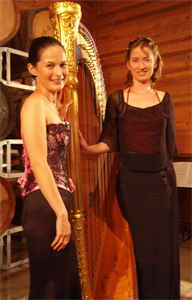
A varied program of music performed by some of Australia's finest musicians will be presented in three splendid locations. Five different concerts in as many days! The Festival will begin with a concert performed in the inspiring surroundings of Meadowbank Estate on Thursday 7 February at 7pm. This will showcase the wonderful talents of soprano Annalisa Kerrigan and harpist Genevieve Lang (see left) along with string players from the TSO in a program of concert arias and Baroque string music. Performers will include: soprano Annalisa Kerrigan, harpist Genevieve Lang; violinists Lucy Carrig-Jones, Anthea Hetherington, Chris Nicholas, Yue Hong Cha; Jo St Leon, viola, cellist Brett Rutherford and Stephen Martin, double bass. Stoney Vineyard's marvelous Barrel Room will provide an excellent setting for the second concert in the Festival on Friday 8 February at 7pm, which will feature a performance of Schubert's celebrated Trout Quintet, perhaps the most popular piece of chamber music ever written. Its celebration in An Equal Music by Vikram Seth in1999 has only added to its perennial popularity.
For the fourth concert of the Festival, brilliant violinist Peter Tanfield and renowned pianist David Bollard, will give a recital at Stoney Vineyard on Sunday 10 February 7pm. The program will include the music by Edvard Grieg, Josef Suk, Fritz Kreisler and Henryk Wieniawski. Historic St John's Church, overlooking the delightful village of Richmond, will provide a wonderful setting for the fifth and final concert of the Festival. The chamber orchestra St John's Camerata will be directed by Peter Tanfield in a performance of music which will include two concerto grosso ( Corelli Op 6 No 5 in B flat major and Handel Op 6 No 6) the popular St Paul's Suite by Gustav Holst and J S Bach's Violin Concerto in A with Peter Tanfield as soloist. The performers will be Con Lavroff, Doris Kouw, Christine Dodd, Jane Flemming, Anita Schleebs, Tahnee George, Shirley Jeffrey, Malcolm McCleod, violins, Catherine Prideaux, Erica Davidson, Karen McCrone, violas, Kate Calwell, Kate Mooney, cellos, Brian Parkinson, double bass. |
|||
 In
1785, Wolfgang Amadeus Mozart wrote a set of six string quartets which
he dedicated to his friend and mentor Joseph Haydn. Arguably the most
popular of these six is this one in C major, also called the
"Dissonance Quartet", considered some of Mozart's finest quartet
writing, and certainly one of the most beloved pieces in the entire
chamber music repertoire.
In
1785, Wolfgang Amadeus Mozart wrote a set of six string quartets which
he dedicated to his friend and mentor Joseph Haydn. Arguably the most
popular of these six is this one in C major, also called the
"Dissonance Quartet", considered some of Mozart's finest quartet
writing, and certainly one of the most beloved pieces in the entire
chamber music repertoire.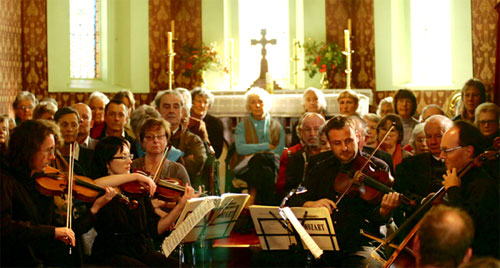
 The
Baroque Concert will be repeated in the South as the first concert in
The Coal Valley Chamber Music Festival, an adventurous initiative for
our little organisation. After several years of presenting concerts in
vineyards, galleries and historic settings across Tasmania, February
2008 will find us concentrated in one location, the beautiful Coal
Valley in Southern Tasmania, which includes the historic village of
Richmond, for a five-day Festival of fine chamber music.
The
Baroque Concert will be repeated in the South as the first concert in
The Coal Valley Chamber Music Festival, an adventurous initiative for
our little organisation. After several years of presenting concerts in
vineyards, galleries and historic settings across Tasmania, February
2008 will find us concentrated in one location, the beautiful Coal
Valley in Southern Tasmania, which includes the historic village of
Richmond, for a five-day Festival of fine chamber music.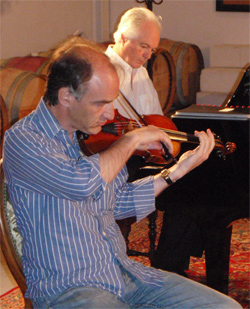 Performers will be David Bollard, piano; Peter Tanfield, violin (see right);
Jo St Leon, viola; Ivan James cello and Stephen Martin, double bass. On
the program will be a recital by soprano Jane Edwards with David
Bollard, piano and Jo St Leon, viola.
Performers will be David Bollard, piano; Peter Tanfield, violin (see right);
Jo St Leon, viola; Ivan James cello and Stephen Martin, double bass. On
the program will be a recital by soprano Jane Edwards with David
Bollard, piano and Jo St Leon, viola.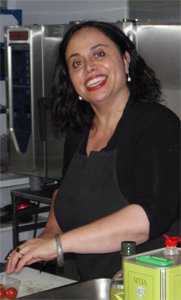 The
Barrel Room at Stoney Vineyard is also the venue for the third concert,
Saturday 9 February at 11am. Virtuosi Tasmania will present for the
first time a jazz concert! Jazz is often considered to be the chamber
music of the 20th century. The concert will be A Tribute to Bill Evans
and will feature a classic jazz piano trio (Randal Muir, piano, Stephen
Martin, double bass and Eric Johnstone drums) with vocalist Maria
Lurighi (see left).
The
Barrel Room at Stoney Vineyard is also the venue for the third concert,
Saturday 9 February at 11am. Virtuosi Tasmania will present for the
first time a jazz concert! Jazz is often considered to be the chamber
music of the 20th century. The concert will be A Tribute to Bill Evans
and will feature a classic jazz piano trio (Randal Muir, piano, Stephen
Martin, double bass and Eric Johnstone drums) with vocalist Maria
Lurighi (see left).